- Analyzed Investing
- Posts
- Fragile Optimism: Investors Navigate Rising Risks
Fragile Optimism: Investors Navigate Rising Risks
U.S. markets are rallying on easing inflation and strong inflows—but geopolitical tensions and looming tariff shocks threaten to derail gains. Find out why this optimism could crumble faster than investors expect.

Analyzed Investing
February 20, 2026
In partnership with

February 20, 2025
Investors Tilt Toward Value and Stability
The current week saw U.S. equity funds attract its largest volume of capital inflows in five weeks, as easing inflation concerns lifted hopes of Fed rate cuts.

Investors favored value over growth and applied selectivity within technology, while industrials and certain tech sectors also drew capital. Bond funds continued a multi-week streak of net purchases, particularly in short- to intermediate-term government and investment-grade funds, reflecting a search for stability and yield.
Money market funds saw strong inflows as well, suggesting a cautious approach and readiness to deploy cash opportunistically. Overall, flows signal a strategic tilt toward diversified, balanced exposure amid evolving market conditions.
Interestingly enough, there seems to be minimal movement in bond yields, indicating that while investors are actively rotating capital, the broader interest rate environment remains steady. This stability suggests the market is digesting the prospects of Fed action without overreacting, favoring measured positioning over aggressive speculation.
At the stock level, selective buying continues to reward companies with clear earnings visibility and resilient cash flows, while sectors sensitive to economic swings experience more restrained interest. The combined picture points to a cautious but constructive market stance, where capital is being deployed thoughtfully, balancing growth potential with defensive buffers in both equities and fixed income.
Stop Drowning In AI Information Overload

Your inbox is flooded with newsletters. Your feed is chaos. Somewhere in that noise are the insights that could transform your work—but who has time to find them?
The Deep View solves this. We read everything, analyze what matters, and deliver only the intelligence you need. No duplicate stories, no filler content, no wasted time. Just the essential AI developments that impact your industry, explained clearly and concisely.
Replace hours of scattered reading with five focused minutes. While others scramble to keep up, you'll stay ahead of developments that matter. 600,000+ professionals at top companies have already made this switch.
SCOTUS Tariff Ruling Could Spark Increased Macro Volatility
The Supreme Court is scheduled to issue a ruling on the IEEPA tariffs—specifically in the case of Learning Resources, Inc. v. Trump—with a decision expected as early as today, February 20, 2026. The Supreme Court is expected to challenge the use of the International Emergency Economic Powers Act (IEEPA) to impose sweeping tariffs.
Activity on prediction markets, such as Polymarket, seem to suggest that the Supreme Court may rule against the current tariff structure set up by President Trump.

Similarly, legal analysts suggest the Court may lean toward limiting executive tariff authority. If ruled unlawful, the U.S. government could be liable for roughly $140 billion in refunds to importers. However, the administration has already floated "credits" rather than cash refunds, which could lead to years of additional litigation
However, the market's true fear isn't the ruling—it's the Administration's "Plan B.". The administration has signaled it will immediately pivot to other statutes (like Section 232 for national security or Section 122 for balance-of-payments).
Rapid tariff reinstatements via other laws could keep inflation sticky, forcing the Fed to remain hawkish despite cooling growth. Similarly, a ruling against the administration might initially weaken the USD, but aggressive "Plan B" tariffs could spark a flight back to the dollar as global trade tensions reignite.
Shockwaves From Iran Could Disrupt Market Optimism
In recent days, the "Iran Factor" has transitioned from a background concern to a primary market driver, causing a noticeable "tug-of-war" between bullish economic data and geopolitical fear.
While capital inflows into US equities are trending upwards, this optimism could could be swiftly derailed by a "kinetic event" in the Persian Gulf. As of late February 2026, the market is no longer just watching from the sidelines; it is actively pricing in a "war premium" that threatens the very foundation of the current rally.
In fact, despite strong inflow trends, major US market indices all closed in negative territory on Thursday, February 19, snapping a three-session winning streak.

Brent crude is already testing $72 per barrel. Analysts at Capital Economics warn that a direct strike could push oil to $80 immediately, while a disruption of the Strait of Hormuz (which handles 20% of global oil) could send prices north of $100. This would likely freeze the Fed's planned rate cuts, as higher energy costs filter back into consumer prices.
Uncertainty is driving investors into the safety of the US Dollar and Gold (now hovering near $5,000/oz). If tensions persist, a spike in Treasury yields—driven by inflation fears—could make the high valuations of US tech stocks look unsustainable.
Strategy Spotlight: Deep Tech
In a volatile landscape shaped by geopolitical conflict and shifting trade laws, active management offers a strategic "buffer" that passive indexing cannot.
As we look toward the potential Iran conflict and the imminent Supreme Court (SCOTUS) tariff ruling, active analyst-led funds are particularly relevant right now.
Here’s why:
1. "Cockroach Avoidance" in Trade Chaos
The pending SCOTUS decision on the International Emergency Economic Powers Act (IEEPA) could either uphold current tariffs or trigger a massive, chaotic refund process.
Passive Risk: An index fund (like an S&P 500 ETF) must hold every company in the index, regardless of how exposed they are to tariff-related margin compression.
Active Advantage: Analysts can pinpoint "bifurcated" winners and losers. For example, they can pivot away from retailers with thin margins vulnerable to tariff spikes and move toward companies with domestic "fortress balance sheets" that benefit from the $200B–$300B fiscal stimulus coming from the "One Big Beautiful Bill" enacted in late 2025.
2. Real-Time Geopolitical Agility
A passive fund only rebalances periodically (often quarterly). In a "kinetic" scenario in the Persian Gulf, a three-month wait is an eternity. Alternatively, active managers can immediately hedge portfolios by increasing exposure to North American Energy and Defense stocks.
One smart way to navigate these uncertain tides is through Surmount AI’s T Rowe US Equity Research Tracker.
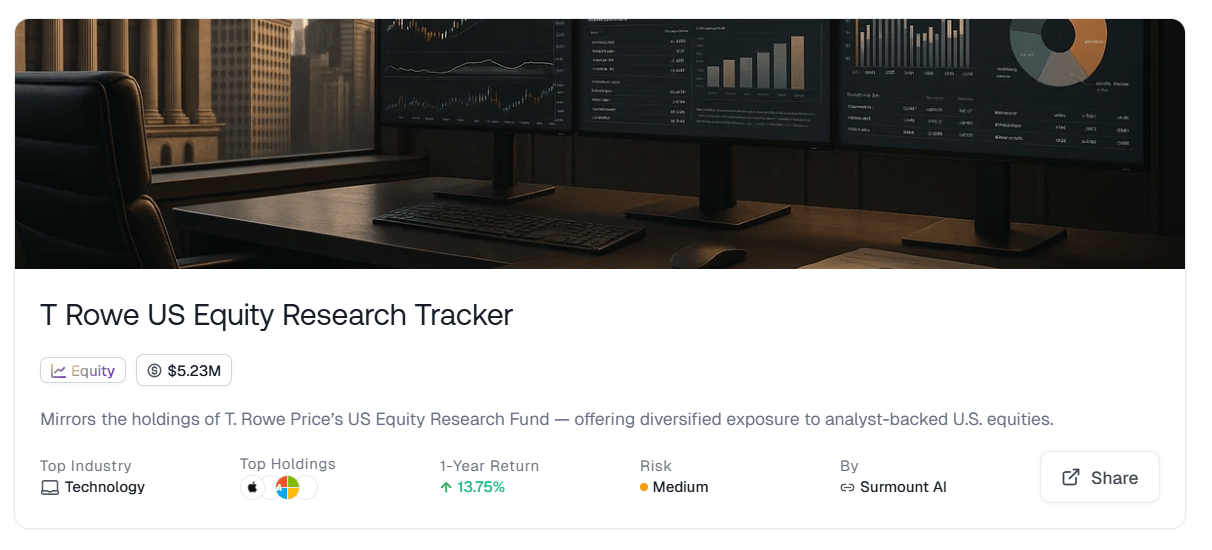
This strategy mirrors the fund’s carefully curated holdings, giving you diversified exposure to U.S. equities handpicked by seasoned analysts.
When geopolitical tensions and inflation spikes hit, lower-quality companies often buckle under debt pressure. Active managers spot these “cockroaches” and avoid them, while seeking resilient, high-yield opportunities that passive funds might indiscriminately hold.
It’s a way to stay in the game, capture upside, and let expert insight guide your portfolio—without the guesswork.
What's Actually Happening
Investor Behavior: U.S. equity and bond funds saw strong inflows, with investors favoring value, stability, and selective tech, while money markets absorbed cash for opportunistic deployment. Overall, positioning is cautious but constructive.
Interest Rates & Yields: Bond yields remain stable, suggesting the market is digesting potential Fed moves without overreacting.
Stock Selection: Companies with clear earnings visibility and resilient cash flows are attracting capital; economically sensitive sectors lag.
Supreme Court Tariff Ruling: A decision on IEEPA tariffs could force $140B in refunds. Markets fear the Administration’s “Plan B” could reimpose tariffs, keeping inflation sticky and complicating Fed policy.
Geopolitical Risk – Iran: Rising tensions are pricing in a “war premium,” with oil prices testing $72/barrel and potential spikes threatening Fed rate cuts and tech valuations.
Overall: Markets are showing cautious optimism, but optimism is fragile—vulnerable to tariffs, geopolitical shocks, and inflation surprises.
Until next week,
Analyzed Investing