- Analyzed Investing
- Posts
- Could the Strait of Hormuz Be the Pin That Bursts the AI Bubble?
Could the Strait of Hormuz Be the Pin That Bursts the AI Bubble?
Where the digital frontier hits the physical wall: why the future of Silicon Valley is currently being decided in the waters of the Persian Gulf.

Analyzed Investing
March 20, 2026
Sponsored by

March 20, 2025
Why $120 Oil is the AI Killer
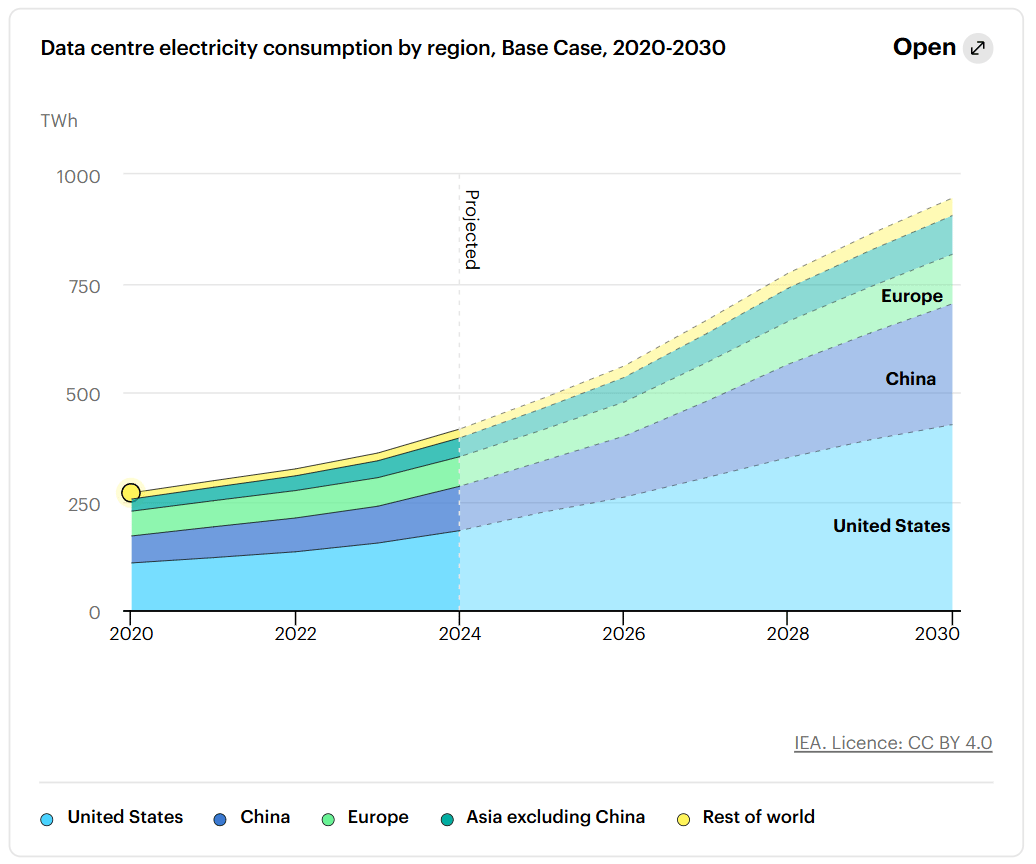
The AI proliferation boom has had an incredible run in recent years. Since the "AI big bang" triggered by the launch of ChatGPT in November 2022, the sector has transitioned from a niche computational discipline into a multi-trillion-dollar general-purpose technology. This is apparent in the sustained boom seen in the number of data centers across the globe:

These dynamics have led to unrestrained optimism by many towards the financial potential of AI, fueling a "valuation-at-all-costs" mentality. While many have called out the clear indications of a massive bubble, the focus has largely remained on software saturation or the "diminishing returns" of larger models. But bubbles don't always pop from internal pressure; often, they are punctured by a sharp, external reality.
Enter 2026, and the military conflict with Iran.
With the Strait of Hormuz essentially choked and no clear timeline for a de-escalation, the "infinite growth" narrative of Silicon Valley has collided head-first with the cold, hard physics geopolitics and war.
For three years, the market treated AI as a pure software play—a realm of ethereal bits and soaring valuations existing somewhere "in the cloud." But the cloud has a physical address, and it runs on a massive, unrelenting diet of electricity.
The current blockade has sent Brent Crude screaming toward $120 a barrel, dragging global LNG prices along with it. This isn't just a headache for commuters; it is a systemic shock to the AI "tax"—the foundational cost required to train, power, and cool the world’s most advanced neural networks.
The Energy Dynamics Have Violently Been Shaken
The AI proliferation boom was built on the back of underpriced energy. When power was cheap, "efficiency" was a secondary concern to "scale." Investors rewarded companies for building larger models with higher parameter counts, rarely questioning the $0.05 per kWh power assumptions baked into their margins.
Today, that math is broken. With the Strait closed, the energy required to run a single high-end inference cluster has effectively doubled in cost. We are witnessing the "Digital-Physical Paradox":
The Digital: AI capabilities continue to move at exponential speeds.
The Physical: The infrastructure supporting that movement is tethered to a 21-mile-wide maritime chokepoint.
The AI bubble risks facing a pop, when the cost of operation exceeds the value of the output.
As the "AI tax" rises alongside oil prices, the ROI on enterprise AI projects is evaporating. If the fuel for the Fourth Industrial Revolution becomes a luxury good, the multi-trillion-dollar valuations of the "Magnificent Seven" aren't just overstretched—they are fundamentally unsustainable in a high-energy-cost environment. The Strait of Hormuz isn't just a shipping lane; it is the oxygen supply for the global data center economy. And right now, the world is holding its breath.
The Tactical Pivot: Introducing the "GLD-Tech Rotation" Strategy
If you’ve followed our research, you know that the traditional 60/40 portfolio is ill-equipped for a world where a single shipping lane can vaporize a trillion dollars in tech market cap.
As we stare down the barrel of a $120 oil reality, the question isn't whether to "buy the dip" in tech—it’s how to rotate before the floor falls out. That is why I am currently highlighting a specific automated framework for this high-volatility regime: The GLD-Tech Rotation.

Why This Strategy? Why Now?
In a "Hormuz Shock" environment, the market splits into two camps: the Digital Growth (TQQQ), which is currently being strangled by energy costs, and the Physical Safety (GLD), which serves as the ultimate hedge against geopolitical chaos and fiat instability.
The GLD-Tech Rotation doesn’t ask you to guess which one will win today. It uses a sophisticated algorithmic approach to do the heavy lifting for you:
Momentum Capture: The strategy runs a daily rebalance, programmatically shifting weight into the relative outperformer. When tech is rallying on AI hype, it rides the TQQQ wave; the moment the "Hormuz Pin" pricks that bubble, the algorithm rotates your capital into GLD.
The Volatility Kill-Switch: Unlike "dumb" buy-and-hold strategies, this uses Bollinger Band logic. If prices drift more than 1.5 standard deviations from the 20-day average—signaling an "extreme" move or a potential crash—the strategy automatically de-risks, moving 50% of your capital to the sidelines to preserve your principal.
Built for the "Barbell" Economy: It perfectly mirrors my "Strategic Barbell" thesis—balancing high-octane tech upside with the unshakeable floor of physical gold.
Don't wait for the supply chain to snap. You can deploy this automated logic directly to your brokerage via Surmount and let the math handle the madness.
Your $4T Wealth Multiplier: Secure an 18.8% return
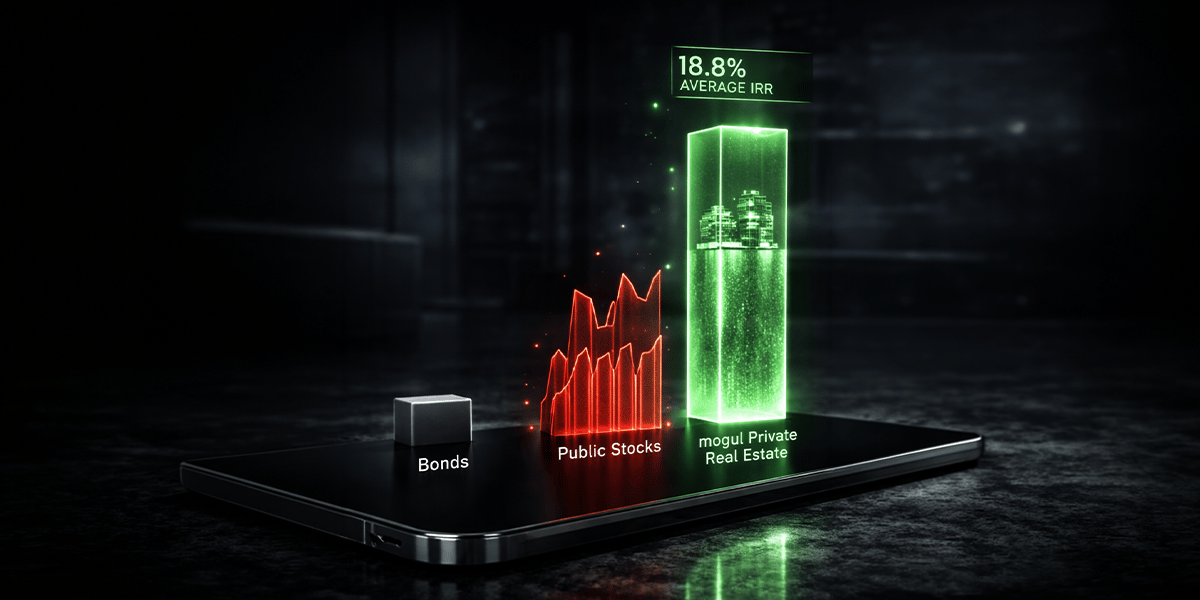
Why settle for 2% dividends when Wall Street dominates a $4 trillion market yielding 3x that? You can access the Goldman Strategy thanks to mogul.
They let you invest in elite rentals for less than the cost of a new Rolex. The Ex-Goldman veterans who handled $10 billion of institutional capital even pick the properties and manage them for you. That means all you need to do is watch the rent checks hit your bank account and relax.
Here’s The Breakdown:
7-12% Annual Cash Yields
18.8% Average Annual IRR for superior long-term growth.
Full Tax Benefits of direct real estate ownership.
Stop watching from the sidelines while institutional giants harvest the yield in your neighborhood. Secure your share of the most resilient asset class on earth today.
Past performance isn't predictive; illustrative only. Investing risks principal; no securities offer. See important Disclaimers
Data Centers vs. The Grid
According to the International Energy Agency, AI’s electricity needs are expected to reach as high as 1050 TeraWatts by the end of this year, which is roughly equivalent to the annual electricity needs of a country like Japan.
Prior to the conflict erupting in the Middle East, the market hardly ever considered energy as a critical constraint; it was treated as an infinite, low-cost utility. But in 2026, the "compute-at-any-cost" era has hit a physical wall.
The "Margin Shredder": $120 Oil and the AI Cloud
While the front end of a chatbot looks clean, the back end is a sprawling complex of cooling fans, backup generators, and high-voltage transformers.
With the Strait of Hormuz currently offline, global energy markets are in a state of "forced rationing." For hyperscalers like Microsoft, Google, and AWS, the impact is two-fold:
Operating Expenditure (OpEx) Explosion: Data centers that relied on natural gas or oil-backed grids are seeing their power bills double. When electricity costs represent up to 40% of a data center’s total overhead, a spike in global energy prices acts as a direct tax on AI margins.
The Cooling Crisis: It’s not just about powering the chips; it’s about cooling them. As ambient temperatures rise and energy for HVAC systems becomes a luxury, the "Price per Inference" for models like GPT-5 or Gemini 2 is skyrocketing, forcing providers to choose between eating the losses or pricing out their enterprise customers.
Ultimately, the conflict in the Gulf has exposed the fragility of the "Global Grid." Most AI hubs were built on the assumption of a stable, fossil-fuel-subsidized energy transition. Now, as governments prioritize residential heating and essential services over "digital vanity projects," AI companies are facing a grim reality: Grid Curtailment.

In the current 2026 macro environment, we are seeing the first instances of "Compute Blackouts"—where data centers are forced to throttle capacity during peak hours to stabilize national grids. For an industry valued on the premise of 24/7, exponential growth, these physical limitations are the ultimate "valuation killers."
The "Energy-Efficiency" Trap
Investors who bought into AI at 50x earnings assumed that hardware efficiency (the move from H100s to Blackwell and beyond) would outpace energy costs. They were wrong. The Jevons Paradox suggests that as AI becomes more efficient, we simply use more of it—leading to even higher total energy demand. With the Strait closed, we no longer have the luxury of "using more."
The market is beginning to realize that if you can't fuel the GPUs, the trillions of dollars spent on the chips themselves become "stranded assets." The AI bubble has revealed itself as an energy-dependent ecosystem that could hit a wall.
Shifting From "Expansion" to "Efficiency"
If a company’s path to profitability depends on sub-5-cent kilowatt-hours and a seamless Asian supply chain, their business model is no longer viable in a de-globalized, energy-starved world.
In the post-mortem of this bubble, the "winners" won't be the companies with the most parameters, but those with the highest Energy-to-Inference efficiency.
The Hyperscaler Pivot: Watch for a brutal sell-off in firms that cannot pass energy surcharges onto their customers.
The Rise of Edge AI: As centralized data centers become "cost-prohibitive" due to grid strain, the value shifts toward decentralized, low-power hardware that doesn't rely on a massive, oil-dependent cooling infrastructure.

Is Your Portfolio "Energy-Blind"?
The Strait of Hormuz conflict has exposed a massive blind spot in tech investing: the "Cloud" is actually a series of massive, power-hungry buildings tethered to the most volatile shipping lane on Earth. The crash we are witnessing isn't a failure of AI's potential; it’s a market correction for an industry that ignored its own physical foundations.
The question for your portfolio isn't whether AI is the future—it is. The question is whether the companies you own can survive a future where the "fuel" for that intelligence is no longer guaranteed. In 2026, efficiency is the only alpha.
This Week’s Takeaways
The End of "Infinite" Scale: The effective closure of the Strait of Hormuz has proved that AI’s growth isn't limited by code, but by the physical reality of $110+ Brent crude hitting data center margins.
The "Yuan-for-Oil" Pivot: Iran’s new "selective blockade"—allowing transit only for yuan-settled trades—is a direct attack on the petrodollar that could permanently rewire how global tech giants finance their energy needs.
The Hardware Freeze: With Qatar’s helium and Gulf energy restricted, South Korea’s DRAM and NAND production is now on a "ticking clock," turning a software boom into a hardware drought.
Sentiment Rotation: Investor focus has violently shifted from "AI Potential" to "AI ROI," as surging power costs make high-expenditure models look like liabilities rather than assets.
The New Alpha: In a world of expensive energy, the market’s new winners won't be the companies with the largest LLMs, but those with the most radical power efficiency and sovereign energy supply chains.
Until next week,
Analyzed Investing
Want more like this?
I publish deeper dives and contrarian macro analysis at AnalyzedInvesting.com.
You can also find me on StockTwits and X.